
Ahmad Farouk Musa || 3 November 2026
Abstract: This study examines the biography of a prominent modern Jewish convert to Islam, born as Leopold Weiss in 1900 into a rabbinical Jewish family. Despite his religious upbringing, Weiss was disillusioned with Judaism at an early age and later pursued studies in art history and philosophy at University of Vienna. Seeking intellectual and existential fulfilment, he travelled to Jerusalem with his uncle Dorian. It was there that he became deeply engaged with the political realities of Palestine. In 1922, while in Jerusalem, he confronted Dr Chaim Weizmann, the leader of the Zionist movement, articulating his growing concerns about Jewish settlement in the region. During his years in the Middle East, Weiss observed what he perceived as increasing European encroachment on Muslim cultural life and political independence. He regarded the Zionist project as an artificial transplantation of European problems into a foreign land, imposed upon an indigenous Arab population. From his perspective, the Arabs were defending themselves against an externally imposed transformation and an impending catastrophe. Subsequently, Weiss worked as a reporter with Frankfurter Zeitung, one of Germany’s most prestigious and influential daily newspapers. His extensive travels across the Middle East enabled him to engage with leading Muslim intellectuals, including Shaikh Mustafa al-Marāghi, a student of Muhammad Abduh. Although deeply attracted to Islam, Weiss initially hesitated to abandon his inherited faith. However, following a series of profound spiritual experiences, he became convinced of the divine origin of the Qur’ān, perceiving in it a voice transcending that of Prophet Muhammad himself. He ultimately embraced Islam and adopted the name Muhammad Asad – Muhammad in honour of the Prophet and Asad being the Arabic rendition of his root name Leo.
Keywords: Leopold Weiss, Zionism, Chaim Weizmann, Frankfurter Zeitung, Muhammad Asad
Introduction
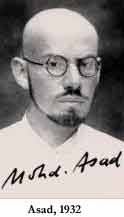 Muhammad Asad (1900-92) was a converted Jew, born on July 2, 1900, as Leopold Weiss. He was an extraordinary convert. He was unlike other converts who sought personal fulfillment in their adopted faith; he sought to shape the course of Islam during his lifetime as a writer, traveller, diplomat, and translator of the Qur’ān. He died on February 20, 1992, at the age of ninety-one. Although his modernist and reformist thought drew heavily on the foundational principles of the renowned Islamic scholar Imām Muhammad Abduh, whose ideas have influenced every trend in contemporary Islam, he remains a somewhat obscure and understudied figure in mainstream history.
We understand that no biography of Asad exists, so the best primary source for his life remains Asad himself. We will try to overcome this obstacle and make use of additional sources for Asad’s life. But the purpose here is more modest. We tried to draw a general sketch of Asad’s life and emphasise Muhammad Asad’s background. This will help us understand his thoughts and the way he thinks better.
The Drift from Judaism
Leopold Weiss was born in the town of Lviv in eastern Galicia – now part of Ukraine – which was then under the Habsburg Empire. At the turn of the century, a quarter to a third of the population of Lviv were Jews, mostly Poles and Ukrainians. Over the previous century, the Jewish community had grown and prospered through commerce and banking. Leopold Weiss’s mother, Malka, was herself the daughter of a wealthy local banker, Menahem Mendel Feigenbaum. They lived comfortably and, as Weiss noted, lived for the children.
According to Weiss, his roots in Judaism ran deeper on his father’s side. His grandfather, Benjamin Weiss, was one of a succession of Orthodox rabbis in Czernovitz in Bukovina, a historical region in Eastern Europe, now divided between northern Romania (Suceava County) and southwestern Ukraine (Chernivtsi Oblast). He remembered his grandfather as a white-bearded rabbi who held rabbinic learning in the highest regard and wished his son – Weiss’s father – to enter the rabbinate. His father, Akiva, studied Talmud by day but secretly learned some worldly sciences by night. He eventually announced his break from the rabbinate, perhaps foreshadowing his son’s own rebellion against Judaism. Somehow, because of circumstances, Akiva managed to study physics but became a barrister instead. He first practiced in Lviv, then in Vienna, Austria, where the family settled before the First World War broke out.
According to Weiss, both his parents had little religious faith. In his own words, Judaism had become for them “the wooden ritual of those who clung by habit—and only by habit—to their religious heritage.” He suspected that his father regarded all religion as superstition. But somehow, his grandfather had him spend long hours studying the Hebrew Bible, Targum, Talmud, Mishna, and Gemarra with a tutor. “By the age of thirteen,” he attested in his autobiography, The Road to Mecca, “I not only could read Hebrew with great fluency but also spoke it freely.” He also mastered Aramaic, which helped him master Arabic in later years (Asad, M. 1996, p. 55; 2019, p. 57). Accordingly, he studied Targum “just as if I had been destined for a rabbinical career.” Similarly, he could “discuss with a good deal of self-assurance the differences between the Babylonian and Jerusalem Talmuds,” as he described in the book (Asad, M. 1996, pp. 55-56; 2019, pp. 57-58).
Nevertheless, he developed a kind of haughty feeling toward the tenets of Judaism. He has no issues with the moral precepts, but he feels that “God in the Hebrew Bible and Talmud was very concerned about one particular nation, the Hebrews” (Asad, M. 1996, p. 56; 2019, p. 58). Besides, the God represented in the holy books seemed to be a tribal deity, more concerned with one particular race – the chosen people. This somehow led him to drift away from Judaism and all other institutionalised religion. “Theological and philosophical ideas did not yet really concern me. What I was looking forward to was not much different from the expectations of most other boys: action, adventure, excitement” (Asad, M. 1996, p. 56; 2019, p. 58).
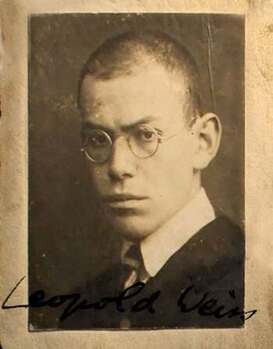 Somehow, this early disillusionment did not lead him to pursue another alternative spirituality; instead, he experienced a spiritual vacuum. Right after the First World War, around 1918, he entered the University of Vienna. He studied the History of Arts and Philosophy. However, at night he spent time in cafés, listening to debates among psychoanalysts such as Alfred Adler, Herman Steckl, and Otto Gross (Asad, M. 1996, pp. 57-59; 2019, pp. 59-61). But then he became disillusioned with his studies, and despite his father’s strong protests, he decided to pursue journalism and left for Prague, eventually ending up in Berlin (Asad, M, 1996, p. 60; 2019, p. 62). There, he joined another group of littérateurs at the Café des Western, where he initially struggled to secure a position as a journalist; he eventually had filmmaker F.W. Murnau tutor him (Asad, M. 1996, pp. 61-62; 2019, p. 63-64). However, his interaction with Murnau was brief. Still, he was lucky enough to meet the owner of United Press of America at the Café des Western and eventually became a journalist (Asad, M. 1996, pp. 62-66; 2019, p. 64-68).
The Eastern Experience
In early 1922, while still in Vienna, Leopold Weiss was invited by his uncle, Dorian Feigenbaum, to visit Jerusalem. A psychoanalyst and a pupil of Freud, he had been instrumental in encouraging Weiss to pursue psychoanalysis while at the university. Dorian is the head of a mental institution in Jerusalem. Weiss accepted the invitation and travelled to Egypt by ship and then by train to Palestine (Asad, M. 1996, pp. 74-87; 2019, p. 76-89). He lived with his uncle Dorian in Jerusalem, just a few steps from the Jaffa Gate. From there, Leopold Weiss first felt the reality of Islam and began to explore it. At the same time, the exploration also uncovered the hidden truth about the immoralities of what is known as Zionism (Asad, M 1996, pp. 87-99; 2019, pp. 87-91).
In his own words in The Road to Mecca:
In the Balfour Declaration of 1917, which promised the Jews a ‘national home’ in Palestine, I saw a cruel political manoeuvre designed to foster the old principle, the common to all colonial powers, of ‘divide and rule’. In Palestine, this principle was more flagrant: in 1916 the British promised the ruler of Mecca, Sharif Husayn, as a price for his help against the Turks, an independent Arab state comprising all countries between the Mediterranean Sea and the Persian Gulf. They not only broke their promise a year later by concluding with France the secret Sykes-Picot Agreement (which established French Dominion over Syria and the Lebanon), but also, by implication, excluded Palestine from the obligation they had assumed with regard to the Arabs. (Asad, M. 1996, pp. 93-94; 2019, pp. 95-96).
He continued:
Although a Jewish origin myself, I conceived from the outset a strong objection to Zionism. Apart from my personal sympathy for the Arabs, I considered it immoral that immigrants, assisted by a foreign Great Power, should come from abroad with the avowed intention of attaining to majority in the country and thus to dispossess the people whose country it had been since time immemorial. He was inclined to take the side of the Arabs whenever the Jewish-Arab question was brought up – which, of course, happened very often. This attitude of mine was beyond the comprehension of practically all the Jews with whom I came in contact during those months. They could not understand what I saw in the Arabs who, according to them, were no more than a mass of backward people whom they looked upon with a feeling not much different from that of the European settlers in Central Africa. They were not in the least interested in what the Arabs thought, almost none of them took pains to learn Arabic; and everyone accepted without question the dictum that Palestine was the rightful heritage of the Jews. (Asad, M. 1996, p. 91; 2019, p. 93).
Asad’s moral position was strengthened by the dream-fantasy insight he gained from what he experienced at the Jaffa Gate. In his own words, he said:
One day I noticed a tall Bedouin standing there without motion, silhouetted against the silver-grey sky like a figure from an old legend. His face, with sharp cheekbones framed in a short, red-brown beard, bore an expression of deep gravity; it was sombre, as if he expected something and yet did not feel expectant. His wide, brown-and-wide-striped cloak was worn and tattered – and the fanciful idea came to me, I do not know why that it had been worn out in many months during the danger and flight. Was he, perhaps, one of thar handful of warriors, who had accompanied young David on his flight from the dark jealousy of Saul, his King? Perhaps David was asleep just now, hiding somewhere in a cave in the Judean hills, and this man here, this faithful and brave friend, had stealthily come with a companion into the royal city to find out how Saul felt about their leader and whether it was safe for him to return. And now this friend of David is waiting here for his comrade, full of dark forebodings: it was not good news that they would bring David… (Asad, M. 1996, p. 91; 2019, p. 93)
Subsequently he said:
I knew, with the clarity which sometimes burst within us like lightning and lights up the world for the length of a heartfelt, that David and David’s time, like Abraham and Abraham’s time, were closer to their Arabian roots – and so to the Bedouin of to-day – than to the Jew of today, who claim to be their descendants… (Asad, M. 1996, pp. 92-96; 2019, pp. 94-98).
In Jerusalem, the incessant confrontation between Weiss and the Zionist leaders continued at every turn. He confronted both Menahem Ussishkin, chairman of the Zionist Committee of Action, and Dr. Chaim Weizmann, the undisputed leader of the Zionist movement. He felt that the whole idea of Jewish settlement in Palestine was artificial, and, what was worse, it threatened to transfer all the complications and insoluble problems of European life into a country that might have remained happier without them.
He said:
The Jews were not really coming to it as one returns to one’s homeland; they were rather bent on making it into a homeland conceived on European patterns and with European aims. In short, they were strangers within the gates. And so I did not find anything wrong in the Arabs’ determined resistance to the idea of a Jewish homeland in their midst; on the contrary I immediately realised that it was the Arabs who were being imposed upon and were rightly defending themselves against such an imposition (Asad, M. 1996, p. 93; 2019, p. 95).
 Remember that this happened around 1922, and the book was first published in 1954. Weiss had seen this long ago, the issues arising from the Balfour Declaration and the Sykes-Picot Agreement, and how Palestinians were being robbed of their homeland. The late Prof. Dr Ahmad Syafii Maarif (31 May 1935 – 27 May 2022), popularly known as Guru Bangsa, a scholar and intellectual who was the Chairman of Muhammadiyah between 1998 and 2005, similarly wrote about Leopold Weiss’s anti-Zionist stance in the preface to a small book published by the Islamic Renaissance Front, Risalah al-Qur’ān – Juz ‘Amma with the title: “Muhammad Asad, Risalah Al-Qur’ān dan Dunia Melayu” (Muhammad Asad, the Message of the Qur’ān and the Malay World).
In his crusade against Zionism, he befriended a Dutch poet and journalist, Jacob Israël de Han (1881-1924). This friendship is notable because it was through de Han that Weiss met Emir Abdallah (1882-1951) in the summer of 1923, his first of many meetings with Arab heads of state. De Han also helped Weiss secure journalistic work. At that time, he joined the Frankfurter Zeitung, then one of the most prominent newspapers in Europe (Asad, M. 1996, pp. 96-99; 2019, pp. 98-101). De Han was later assassinated by the Haganah (clandestine Zionist paramilitary organisation) for his strong anti-Zionist views.
Weiss continued to work as a journalist for Frankfurter Zeitung, writing against Zionism with a strong anti-British bias. He became the spokesperson for Arabs and Muslims. In the summer of 1923, better informed about Middle Eastern life and politics, he returned to Jerusalem. Through his acquaintance with Emir Abdallah, he visited Jordan, where he saw the true Bedouin land for the first time, with free warriors and camel breeders. Every man was armed, carrying a dagger in his sash and a rifle on his back (Asad, M. 1996, p. 109; 2019 p. 110). However, he did not intend to stay in Jordan indefinitely.
Weiss had always wanted to go to Syria first. However, the French authorities were unwilling to grant a visa to an Austrian ‘ex-enemy alien’. It was a bitter blow to him, and he decided to go to Haifa instead, but a calamity befell him. He lost his coat, which contained his wallet and passport. He had only a few silver coins in his trouser pocket. Yet he remained adamant about going to Syria. With no passport and no money, he asked himself: was it absolutely necessary to have a passport and money? (Asad, M. 1996, p. 113; 2019 p. 113).
So he travelled on foot to Damascus. Looking back, he felt this journey to Damascus was a calling from God. One Friday, he went to the Umayyad Mosque with his friend. There he had his first epiphany. Weiss narrated:
There was a scent of musk in the air, red and blue carpets covering the floor. In long, even rows stood many hundreds of men behind the imam who led the prayer; thy bowed, knelt, touched the ground with their foreheads, and rose again: all in disciplined unison, like soldiers. It was very quiet,; while the congregation was standing, one could hear the voice of the old imam from the distant depths of the huge hall, reciting verses from the Qur’ān; and when he bowed or prostrated himself, the entire congregation followed him as one man, bowing and prostrating themselves before God as if He were present before their eyes… (Asad, M. 1996, p. 127; 2019 p. 126).
At this time, he realised how close their God and their faith were to these people. Their prayer did not seem divorced from their workday; it was part of it – not meant to help them forget life, but to remember it better by remembering God. He remembered what he had said to his friend:
How strange and wonderful, that you people feel God to be so close to you. I wish I could feel so myself”. His friend replied: How else could it be, O my brother? Is not God, as our Holy Book says, nearer to thee than the vein in thy neck?” (Asad, M. 1996, p. 127; 2019 p. 127).
Then, in the spring of 1924, he was sent by the newspaper on his second journey to the Middle East. By then, he had completed his first book, Unromantisches Morgenland, written in German. As expected, the book had a strong anti-Zionist stance and did not do well in the market. It was later translated by Elma Ruth Harder as The Unromantic Orient.
His journey to the Middle East took two years. This was probably the most significant travel so far. He crossed the Mediterranean and saw the Egyptian coast. He travelled first class by train from Port Said to Cairo. He no longer needed to count pennies. It was there that he befriended Shaikh Mustafa Al-Marāghi (1881 – 1945), one of the most prominent Islamic scholars of the time and the most brilliant among the ulama’ of Al-Azhar University, who was destined to become its Rector some years later (Asad, M. 1996, p. 188; 2019, p. 200). Al-Marāghi was a pupil of the great Egyptian reformer Muhammad Abduh and the firebrand Jamaluddin Al-Afghāni. According to Weiss, Al-Marāghi never failed to impress upon him that Muslims in recent times had fallen very short of the ideals of their faith, and that nothing could be more erroneous than to measure the potentialities of Muhammad’s message by the yardstick of present-day Muslim life and thought (Asad, M. 1996, p. 188; 2019, p. 190).
On one occasion, Al-Marāghi told him something that would later imprint on his mind his main task: to fight taqlid, or blind imitation. Al-Marāghi said:
Dost thou see those ‘scholars’ over there? They are like those sacred cows in India which, I am told, eat up all the printed pages from the books that have been written centuries ago, but they do not digest them. They no longer think for themselves; they read and repeat – and the students who listen to them learn only to read and repeat, generation after generation (Asad, M. 1996, p. 189; 2019, p. 191).
From his interaction with Al-Marāghi, he concluded that:
It was not the Muslims that had made Islam great: it was Islam that made the Muslims great. But as soon as their faith became habit and ceased to be a programme of life, to be consciously pursued, the creative impulse that underlay their civilisation waned and gradually gave way to indolence, sterility, and cultural decay (Asad, M. 1996, p. 193; 2019, p. 195).
Weiss then spent the better part of the next two years traveling. He went to Syria, Iraq, Kurdistan, Iran, and Central Asia, becoming more familiar with the various ways Islam is practiced outside the Middle East.
Conversion to Islam
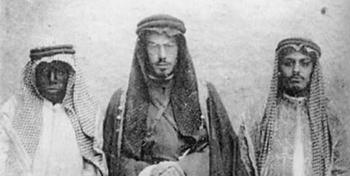 Weiss returned to Frankfurt after completing his travels to begin writing his book. While working on the editorial staff of Frankfurter Zeitung, he frequently visited Berlin. There, he met his future wife, Elsa. He was captivated by Elsa the first time he met her at Romanisches Café, not only by her delicate beauty but also by her sensually intuitive way of approaching people and things. Although she was fifteen years older than Weiss — in her late thirties at that time — her smooth face and slender, flexible body gave her a much younger appearance. He believed Elsa was probably the finest representative of the pure ‘Nordic’ type he had ever encountered (Asad, M. 1996, p. 142; 2019, p. 142).
He was now somewhat complacent with his life. Yet he made no progress on the book he was supposed to write. He had writer’s block and could not put pen to paper to write about his travels. Somehow this led to an altercation with the editor of the Frankfurter Zeitung, which ended with his resignation from the newspaper. He then moved to Berlin, where he studied Islamic Studies and became a writer for lesser-known newspapers, namely the Neue Zürcher Zeitung of Zurich, the Telegraaf of Amsterdam, and the Kölnische Zeitung of Cologne (Asad, M 1996, p. 307; 2019, p. 330).
For the time being, both Elsa and Weiss settled in Berlin, where Weiss intended to complete his series of lectures at the Academy of Geopolitics and to continue his Islamic Studies. Weiss discussed his newly discovered religion of Islam with his old literary friends, but somehow they had grown estranged. He then began to see that, in the eyes of people raised within the orbit of Christian thought, with its stress on the ‘supernatural’ allegedly inherent in every true religious experience, a predominantly rational approach seemed to detract from a religion’s spiritual value.
Weiss knew he was being drawn to Islam, but a final hesitation made him postpone the final, irrevocable step. To him at that time, the thought of embracing Islam was like the prospect of venturing out onto a bridge spanning an abyss between two worlds: a bridge so long that one would have to reach the point of no return before the other end became visible. He was aware that if he became a Muslim, he would have to cut himself off from the world in which he had grown up. He said: “One could not really follow the call of Muhammad and still maintain one’s inner links with a society that was ruled by diametrically opposed concepts” (Asad, M .1996, p. 308; 2019, p. 332).
However, one day in September 1926, while Weiss and Elsa were traveling in the Berlin subway, he experienced his second epiphany. They were in an upper-class compartment with a well-to-do businessman, a beautiful briefcase, and a large diamond ring on his hand, the picture of prosperity one encountered everywhere in Central Europe those days. But when he looked at his face, he did not seem happy. He looked worried: not merely worried, but acutely unhappy, his eyes staring vacantly ahead and the corners of his mouth drawn as if in pain, though not bodily pain. When he turned to the elegant lady next to him, she also had a strangely unhappy expression on her face, as if contemplating or experiencing something that caused her pain. And when he looked around at all the other faces of well-dressed, well-fed people, almost every one of them had an expression of hidden suffering, hidden from themselves (Asad, M. 1996, pp. 308-309; 2019, pp. 332-333).
Weiss had never seen so many unhappy faces around him but when he mentioned to Elsa, she looked around her and was very astonished to the sight of unhappiness surrounding her and she said: “You are right. They all look as though they are suffering torments of hell…I wonder, do they know themselves what is going on with them?” (Asad, M .1996, p. 309; 2019, p. 333).
Returning to his flat, Weiss happened to glance at his table, where a copy of the Qur’ān he had been reading earlier lay open – which would become his third epiphany. Without even thinking, he picked it up to put it away, but just as he was about to close it, his eyes fell on the open page in front of him, which read:
You are obsessed by greed for more and more
Until you go down to your graves
Nay, but you will come to know!
Nay, but you will come to know!
Nay, if you knew it with the knowledge of certainty,
You will indeed see the hell you are in
In time, indeed, you shall see it with the eye of certainty:
And on that Day you will be asked what you have done with the boon of life.
Weiss was speechless. The Qur’ãn shook in his hands. He handed it to Elsa and said: “Read this! Is it not an answer to what we saw in the subway?” (Asad, M, 1996, p. 310; 2019, p. 334).
It was an answer, so decisive that all doubt suddenly ended. He knew then, beyond any doubt, that it was a God-inspired book that could have become true only in this complicated, mechanised, phantom-ridden age. To Weiss, this was not mere human wisdom of a man from a distant past in distant Arabia. No matter how wise he may have been, he may not have foreseen the torment so peculiar to this century. While people had always known greed, at no time before had it outgrown a mere eagerness to acquire things and become an obsession that blurred the sight of everything else (Asad, M. 1996, p. 310; 2019, p. 334).
Together, these three pivotal moments—the Damascus Mosque (the glimpse), the Berlin subway (the contrast), and the Qur’ānic verse (the certainty)—traced the arc of his conversion: from intuition to recognition to conviction. (Musa, 2025)
All doubt that the Qur’ān was a God-inspired book vanished. The next day, he went to the leader of the Berlin Islamic Society, declared the shahada before the community’s imam, and formally embraced Islam (Kramer, M. n.d.). When he told the imam that his name was Leopold, meaning “lion,” the imam suggested the name Muhammad Asad—Muhammad in honour of the Prophet and Asad, which means “lion” in Arabic—a name he kept for the rest of his life.
Conclusion
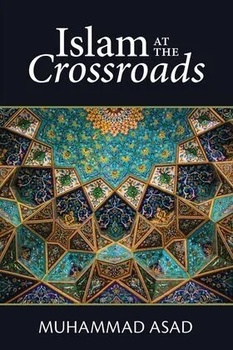 Having learned about Asad’s history, one may wonder about his conversion. Actually, he has no simple explanation. In a book written in 1934, Islam at the Crossroads, he said he must confess that no particular teaching attracted him to Islam, but rather the whole wonderful, inexplicably coherent structure of moral teaching and practical life program. Islam appears to me like a perfect work of architecture. All its parts are harmoniously conceived to complement and support each other; nothing is superfluous and nothing is lacking, resulting in an absolute balance and solid composure. Probably this feeling that everything in the teachings and postulates of Islam is “in its proper place” has made the strongest impression on him. After all, it was a matter of love; and love is composed of many things: of our desires and our loneliness, of our high aims and our shortcomings, of our strength and our weakness. He finally said: “So in my case, Islam came over me like a robber who enters a house by night; but unlike a robber, it entered to remain for good” (Asad, M., 2005, pp. xviii-xix; 2016, pp. xxii-xxiii).
References
Asad, M. (1996). Road to Mecca. Kuala Lumpur: Islamic Book Trust. (2019). Malay translation: Jalan ke Mekah. Kuala Lumpur: Islamic Renaissance Front.
Asad, M. (2004). English translation: The Unromantic Orient. Kuala Lumpur: Islamic Book Trust.
Asad, M. (2005). Islam at the Crossroads. Kuala Lumpur: Islamic Book Trust. (2016). Malay translation: Islam Di Persimpangan Jalan. Kuala Lumpur: Islamic Renaissance Front.
Asad, M. (2011). The Message of the Qur’ãn. Kuala Lumpur: Islamic Book Trust. (2022). Malay translation: Risalah al-Qur’an – Juz ‘Amma. Kuala Lumpur: Islamic Renaissance Front.
Kramer, M. (n.d.). The Road to Mecca: Muhammad Asad. Available from: https://martinkramer.org/reader/archives/the-road-from-mecca-muhammad-asad/#n14 [accessed 9 February 2026].
Musa, A. F. (2025). Speech on the Launching of the Unpublished Letters of Muhammad Asad at HARTA by Habib Jewels, Kuala Lumpur on 6 August 2025. Available from : https://irfront.org/post/speech-on-the-launching-of-the-unpublished-letters-of-muhammad-asad-at-harta-by-habib-jewels-ampang-kuala-lumpur-on-6-august-2025-14620 [accessed 9 February 2026].
 Datuk Dr Ahmad Farouk Musa holds a Master in Surgery from University Sains Malaysia and a PhD in Surgery from Monash University Australia. He is an Assoc. Professor of Surgery at the Department of Surgery, Royal College of Surgeons In Ireland & University College Dublin (RCSI&UCD) Malaysia Campus. He is also a PhD candidate in Islamic Studies at University Muhammadiyah Malaysia. This essay is published in a SCOPUS-indexed Intellectual Discourse Vol. 34 No. 3 (2026).